
Job Search Tips for Hunters and Hirers
I have applied for my fair share of jobs over the years. I have also hired many people.
I’ve learned a lot and want to share some tips for both sides of the job search equation. Whether you’re hunting for a job or hiring for a role, here are my best hot takes for how to stand out and what to look for.
Do not sleep on LinkedIn. It’s not just a digital resume anymore. It’s a place to connect, expand your network, and most importantly - show off your expertise!
Hunters
If you don’t have a profile, make one right now! Beef up as many sections as possible. Use a professional photo - absolutely no blurry selfies. Connect with everyone you know. Then connect with everyone you don’t know that is even tangentially connected to the industry, job, company, or boss that you want to work for.
Don’t be afraid to use AI to help with copy and even jazzing up your profile pic if you don’t have something that looks professional.
Post regularly! Once a week is a good cadence. You should also comment on and engage with others’ posts. LinkedIn allows you to show your experience, expertise, and personality in a way that goes much deeper than your resume and is much more professional than Instagram or Facebook. You can enter an interview with a huge leg up by building authority on LinkedIn before even applying for jobs.
Attending networking events and meeting people IRL before making a connection request can go a long way. Drive all of your in-person connections to LinkedIn, then post and comment regularly to stay engaged and top of mind.
Hirers
Always be recruiting. Connect with people in your industry. Always connect with people on LinkedIn after you meet them (at a networking event, conference, sales meeting, etc.). You never know who will be open to a new opportunity and when. The better network you have on LinkedIn, the easier it will be to post an open position and get high-quality, warm applicants.
Become your ideal hire’s dream company. LinkedIn also allows you to show off your company - what you’re doing, what customers you’re working with, how great your culture is, what your team is like, etc. It’s highly advantageous to you if your LinkedIn connections start to build up an admiration for your company. They’ll be more eager to apply for (and accept) a role or recommend others to apply when the time comes.
Resume & Application Tips
Follow Instructions
Hunters
These days, most job postings get hundreds of one-click applications. It can be very difficult and tedious to sift through all of the unqualified/bare-minimum-effort applications. Because of this, following instructions is a shockingly easy way to not get weeded out in the first round. I have seen more and more job postings that bury secret code words or extra steps to follow if you want to be considered. If you are serious about the role, take your time to carefully read and follow the instructions. If you’re asked to record a video, don’t do it while you’re slouching on the couch with a dark, messy background. Taking a little time show the hirer that you are thorough, professional, and care to make a good first impression can go a long way!
Hirers
Sorting through applications can be extremely overwhelming. We have implemented a step where we put a link to a Google Form in any job site listing (Indeed, LinkedIn) that the applicant has to fill out if they want to be considered. This alone weeds out the vast majority of applicants. In the Google Form application, we ask for a one-way video interview. This weeds out even more. These steps have allowed us to significantly streamline the application process so that we only have to review a handful of strong, serious candidates before scheduling interviews.
Customize it
Hunters
Actually read the job description and tailor your resume to feature the things that the job description asks for. Make the hirer think, “Wow, this is such a perfect fit.” Focus on what the hirer is looking for and how you can bring value. Using a generic resume for every job you apply for is leaving opportunity on the table when you can customize the way you describe your experience to match the job description more closely.
Hirers
If someone can connect their experience with the job at hand, it shows that they have a good understanding of the role and aren’t submitting the same generic resume to hundreds of jobs without even paying attention to what the job is.
Make it skimmable
Hunters
Some job postings receive hundreds of resumes, and it can be difficult and tedious to sort through them all. Don’t bury the lead! Make it easy for the hirer to skim your resume and easily see the key points that make you a great candidate. Highlighting keywords is an easy way to catch the hirer’s eye (see the graphic below).
Hirers
Reviewing resumes can be overwhelming. My take is that if a candidate can easily communicate what traits and elements of their experience apply to the role, it shows that they are a good communicator and have a handle on what the role requires.
Sort by relevance, not recency
Hunters
There is no rule that says you have to put your most recent experience at the top of your resume. Sometimes your current or most recent role is not the most relevant experience to the job you’re applying for. If a previous job (or even a volunteer role) is more relevant, feature that right at the top, then have an “other experience” section somewhere else to fill in time gaps. This is a great technique if you’re trying to change careers. Feature non-job experience or specific projects at the top of your resume to emphasize the alignment in your skills, even if your job experience doesn’t make an obvious connection.
Hirers
Whether the candidate knows to emphasize their most relevant experience over their most recent, take a moment to make that connection yourself. Identify what parts of their experience line up most with the job you’re hiring for and ask about that in the interview. That may be the exact reason the candidate is applying - because they miss aspects of previous experiences and want to reengage those skills.
Make it pop
Hunters
Use a little color and a nice design. Boring, all-text, Microsoft Word resumes can get very monotonous, and when a hirer is reviewing dozens or hundreds of resumes, you’ll want to do what you can to stand out. It shows that you have a good design eye, basic technological skills, and a willingness to go above and beyond. Hot tip: If you really want to show attention to detail, match the accent color of your resume with the company’s brand color!
Hirers
Not only does an aesthetically pleasing design stand out in a stack of boring black and white resumes, but it also shows that the candidate cares, knows how to use tools that are a little more advanced than a basic word processor, and has basic communication and design skills.
Keep it concise
Hunters
I am Team One-Page Resume. The hirer will be skimming anyway. Make it easy for them to identify the key points. Remember that your resume is meant to be a highlight reel, not an autobiography. If I receive a resume that is multiple pages of full paragraphs, I simply do not read it all.
Hirers
Concise communication is an important skill. You want someone who can communicate succinctly and respect your time.
Include a little something extra
Hunters
If you can, include something a little extra with your application. Utilize your resume when you can by including links to your LinkedIn profile and/or portfolio. Include a cover letter that helps make the connection between your experience and the job, and most importantly, why you want the job. If you really want to stand out, send a video cover letter to show your personality and communication skills!
Hirers
It’s very difficult to accurately evaluate someone based on a piece of paper. I will take any additional information I can get if the applicant seems like a good fit. It also shows that they are willing to go above and beyond. Most people will do the absolute bare minimum in the job application process, which is a pretty good indication of what they’ll do on the job.
We require candidates to submit a one-way video interview with their application, where they answer several questions with a 5-minute limit. This has been massively helpful for narrowing down large pools of applicants.
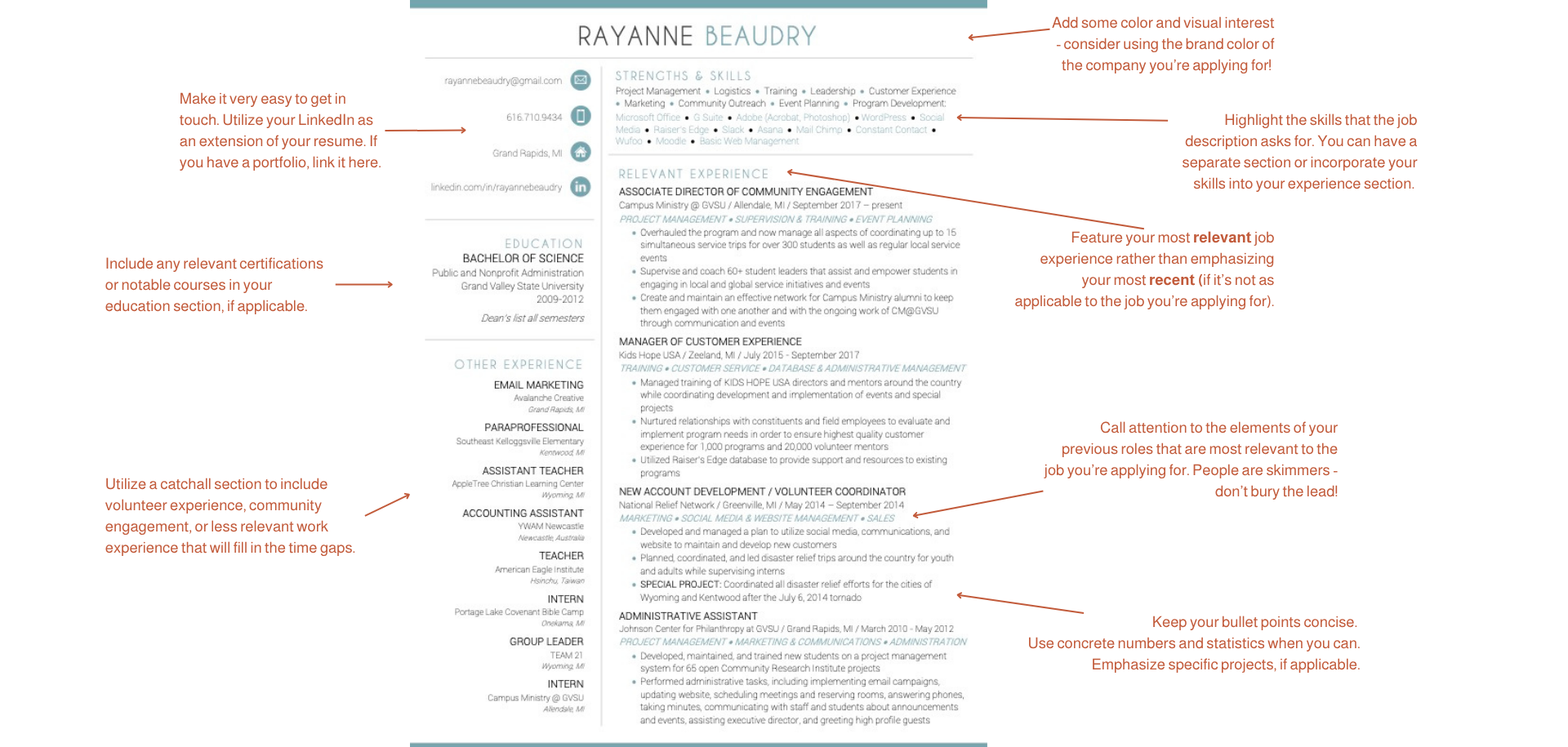
Sample Resume
Interview Tips
Be your authentic self
Hunters
Faking it in the interview will only set you up for failure later on. Be honest about your strengths, weaknesses, skills, and desires. Show your personality and how you like to engage in the workplace. If you don’t know an answer or recognize that your honest answer is probably not what they want to hear, it’s better to acknowledge it than to fabricate an inauthentic response. Be yourself now so you can be yourself on the job.
Hirers
Don’t oversell your company or the culture to the point where you make the job sound like gravy. You want to attract hard workers who aren’t afraid of a challenge, rather than people looking for an “easy” job that won’t ask much of them. You may feel desperate to get the role filled, but don’t just say what you think they want to hear. You want to know that there is going to be good working chemistry and cultural alignment. If you like to be casual and fun in the workplace, don’t be overly professional in the interview (or vice versa). It doesn’t do anyone any favors to portray yourself or your company differently in the interview process than it is in practice.
Focus on the value you’ll bring, not what you’ll take
Hunters
This is so incredibly important, and so many people get this wrong. Everyone wants to have a job that they generally enjoy and makes them feel fulfilled and valued. But you have to remember that in the hiring process, the company is looking to get the best bang for its buck. They don’t know you personally yet, and the harsh truth is that they just don’t care about your student loan bills or that new mortgage that you have to pay for. They want to exchange money for high-quality work. The hirer wants to know what value you’ll bring and how you can help the company long before they want to talk about how they can help you.
Do not, under any circumstances, start asking about pay and benefits or asking too many you-focused questions before you have any indication that the company wants to hire you. It’s a huge turnoff and makes it look like you have a huge ego if you start negotiating before you’ve even impressed the hirer.
Once you have won the hirer over and become the final candidate, they are invested in you, and you will have the upper hand in negotiations. They don’t want to have to start the hiring process over! It’s all about timing.
Hirers
If a candidate is more focused on what you can do for them than what they can do for you, it’s a hard pass. If that is their attitude in the first interview, it will only get worse once they’re hired. Don’t start metaphorically wining and dining candidates until they have proved that they will be a great fit and are worth fighting for.
Trust your gut
Hunters
If the interview feels extremely awkward and lacking in chemistry, that is probably what working for that company will feel like. If you pick up on toxic vibes or that the interviewers aren’t being fully transparent, trust your instincts. First impressions are everything, and if you don’t feel excited about the potential of taking the job, it won’t be a good experience for you or the company.
Hirers
I have learned this lesson far too many times. Regardless of what a candidate is like “on paper,” you will get a vibe from them in interviews. If it inexplicably feels off, trust that gut instinct - and vice versa! If they aren’t necessarily the obvious candidate based on their skills and experience, but you can see and feel their potential, don’t pass on them for the more straightforward candidate.
Show don’t tell
Hunters
Before the interview, prepare several anecdotes from your previous experiences that you can use for “tell me about a time…” questions. Think of situations where you learned an important lesson or made yourself (or your boss) proud. When did you overcome an obstacle, introduce a new way of doing things, resolve a conflict, etc? You can usually work a few good anecdotes into a variety of questions. There is nothing worse than dead air or not being able to come up with an example at all.
Hirers
Asking questions that require the candidate to share past experiences can be a good way to parse through the generic interview answers that are telling you what you want to hear. I want to know what they’ve actually done and how they’ve handled real situations. Role play questions can also be useful (i.e. What would you do if…).
Get ahead of the uncertainties
Hunters
Most good interviewers will leave space for questions at the end. I always end every interview with the question, “At this time, do you have any hesitations about hiring me?” This is a bold question that may open the door for tough feedback, but why leave the interview unsure of how it went? This is a great opportunity to quash any lingering feelings that the interviewer has that may make them hesitant to move forward.
Hirers
If you get to the end of an interview and feel any weird/unsure/hesitant feelings about a specific answer, a mysterious gap in the person’s resume, or an element of their personality, you might as well just be up front about that and get to the bottom of it then and there! Interviewing is an art, and part of that art is knowing when to veer from the written, pre-planned questions and get the clarity you need to make the right decision.
Another opportunity to include a little something extra
Hunters
If the interview is in person, leave them with something tangible. I used to have a folder with my printed resume as well as some writing samples, letters of recommendation, etc. This is another opportunity to be memorable and put that extra touch of care and attention to detail. Even if it’s a virtual interview, you can send a follow-up email that includes links or attachments.
Send a thank you email (or go crazy and send a handwritten card!) that expresses your gratitude, emphasizes how excited you are for the opportunity, and highlights any details you want to reiterate or clarify based on how the interview went.
Hirers
First impressions are important. If the interview is in person, make sure the experience feels comfortable, organized, and professional. For second-round (or beyond) interviews, consider sharing some company swag. If the candidate asks questions in the interview that require (or would benefit from) follow-up, be proactive about providing that promptly.
Negotiation Tips
The first offer is never the final offer
Hunters
If you receive an offer, you have won the hirer over. They have decided that you are the final candidate, and the last thing they want to do is start over. The first offer is never the final offer. They will always come in lower than what they can offer because they expect negotiation. The worst thing that can happen is that they say they can’t go any higher. You’re not going to offend them by asking for more, as long as it’s done politely and is within reason.
Hirers
Assume that the candidate will negotiate. Don’t offer everything you have in the first go. And if you do, make it clear to the candidate that you want them badly enough to make them a best and final offer.
Focus on the value you’ll bring
Hunters
This is even more important here! Never bring up your own personal expenses as a reason to pay you more. The hirer does not care that you have a lot of student loans or five kids to provide for. They want to know that you can provide value to the company. They won’t pay you more than someone else with your same skill set simply because your expenses are higher.
It can sometimes be appropriate to bring in some market research if you feel that the offer is low, but it’s still better to focus on the value you can bring to the specific company. “I am confident I can streamline your service delivery process enough to increase efficiency and reduce expenses by X amount.”
The way you negotiate for more is important. If you ask for way too much or have no reasoning to back it up, it can be a turn-off for the hirer.
Hirers
When it comes down to it, you’re exchanging money for labor. If you can hire someone else to provide the same value for less money, you should. You should absolutely treat people with humanity, but if they have ridiculous demands or are completely self-focused in the negotiation process, that’s not going to be a good employee. There should be a feeling of mutual satisfaction with wherever the negotiation lands.
Everything is negotiable - not just salary
Hunters
If the hirer can’t offer you the salary you desire, think about what else you could ask for that would bring the value up. Can you ask for an additional week of PTO? Can you ask to work from home one day per week? Can you work 4 ten-hour shifts rather than 5 eight-hour shifts? If there is a probationary period for certain benefits, can that be reduced? Is there any opportunity to incorporate commissions or performance-based bonuses? They may say no to everything, but it never hurts to ask. Everyone likes (and needs) money, but most people value something else enough that it can make up for a lower salary.
Hirers
You may be constrained to a certain budget, but consider what else you can offer to sweeten the deal. For example, there is evidence that most people are willing to take a lower salary if they can work remotely. Can you offer additional PTO, a more flexible work schedule, or something else that is less impactful to your bottom line?
